
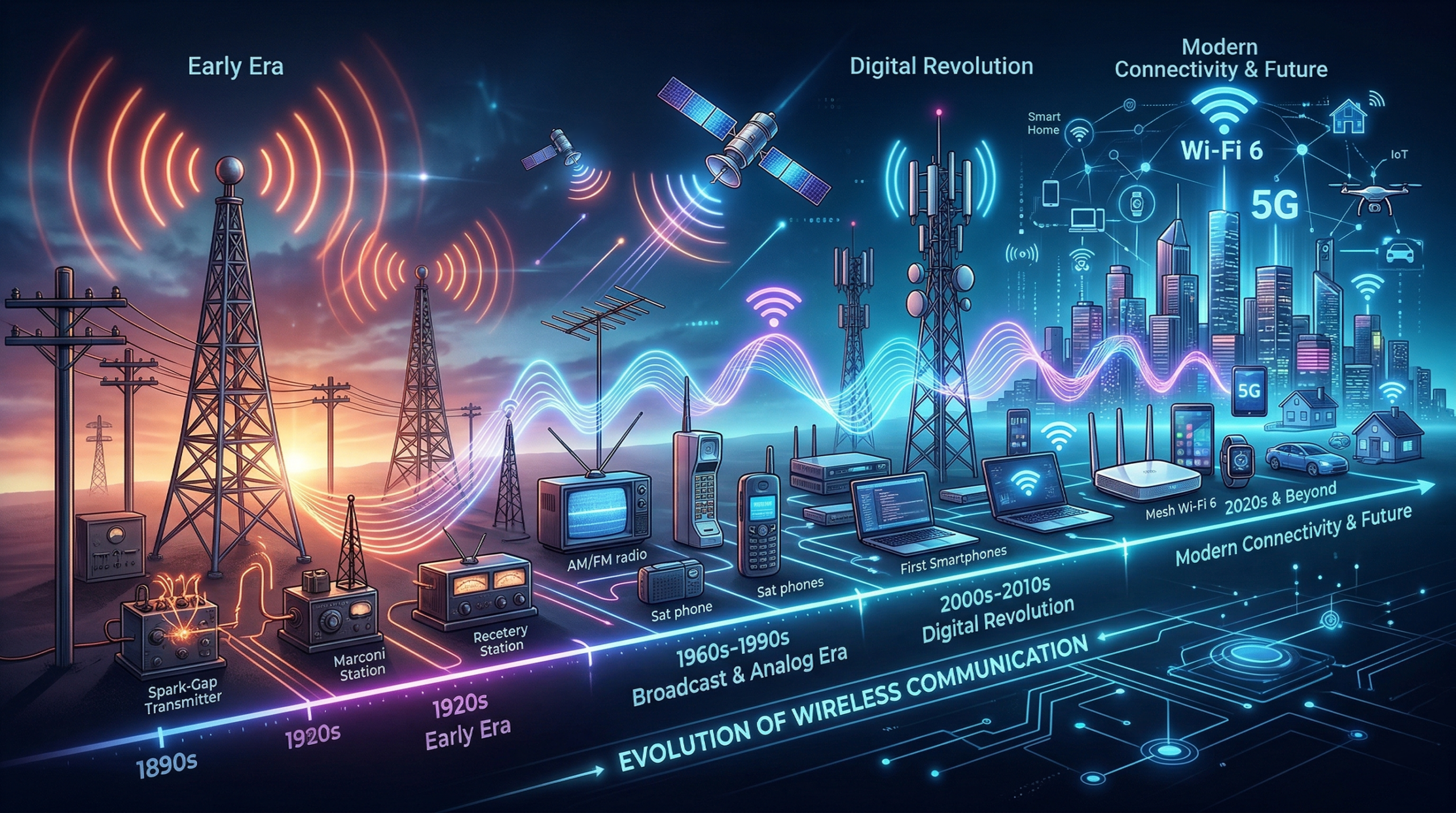

This is the beginning of a series, a deep dive into wireless networks: how they were born, how they evolved, and how they quietly reshaped the world around us.
If you truly want to understand how to approach wireless networks especially Wi-Fi you don’t start with configuration commands or packet captures. You start with history. You start with architecture. You start with why things were built the way they were.
Because once you understand the evolution, you stop seeing Wi-Fi as “just internet without cables.”
You start seeing spectrum strategy.
Protocol decisions.
Engineering trade-offs.
Security implications most people never question.
Throughout this series, I’ll share hard nuggets the kind of insights you’re rarely told in classrooms or quick tutorials.
Wireless communication powers everything from the smartphones in our pockets to the invisible networks running entire cities. And among all wireless systems, Wi-Fi stands out as the technology that made connectivity truly accessible to the masses.
But how did it evolve?
And why does its history matter more than we think?
Let’s go back to where it all began.
The Early Sparks: From Radio Waves to Wireless Networks
Wireless communication started long before Wi-Fi ever entered our homes. Experiments with radio waves in the early 20th century laid the groundwork for wireless data transfer. However, the direct ancestor of modern Wi-Fi began decades later:
- In 1971, researchers developed ALOHAnet, a wireless packet network in Hawaii one of the earliest systems to send data without wires. This pioneering work influenced later wireless network technologies.
The Birth of Wi-Fi: Spectrum Freedom, Smart Minds, and a Global Breakthrough
Every revolution needs two things: freedom and vision.
The freedom came in 1985, when the Federal Communications Commission (FCC) made a historic decision. They opened certain radio frequency bands including 2.4 GHz (and later 5 GHz) for public, unlicensed use.
In simple terms?
You no longer needed special government permission to experiment and build wireless communication systems on those bands.
That decision quietly changed the future.
But spectrum freedom alone wasn’t enough. Devices still had no universal language. Different vendors were building different wireless systems that couldn’t properly talk to each other. It was like everyone shouting across a room in different languages.
Then came standardization.
In 1997, the Institute of Electrical and Electronics Engineers (IEEE) ratified the 802.11 standard the first official framework that defined how wireless local area networks should operate.
The first version supported speeds of just 2 Mbit/s.
Today that sounds painfully slow.
You couldn’t even load a modern meme without waiting.
But at the time? It was revolutionary.
Now here’s where it gets interesting.
Wi-Fi didn’t have just one “father.” It had visionaries in different roles.
Vic Hayes, often called the “Father of Wi-Fi,” chaired the IEEE 802.11 committee and led the global effort that turned wireless LAN technology into a unified standard. Without that leadership, Wi-Fi might have remained fragmented and incompatible.
At the same time, Australian engineer John O’Sullivan and his team at CSIRO developed key radio technologies originally while researching radio signals from black holes that later became foundational to high-speed Wi-Fi systems.
Yes Wi-Fi exists partly because scientists were trying to detect exploding black holes in space.
Talk about accidental innovation.
One helped the world agree on how Wi-Fi should work.
The other helped make it technically possible at high speeds.
Together, their contributions shaped the wireless world we know today.
“Wi-Fi” Gets Its Name: From Technical Jargon to Global Brand
Now here’s something interesting.
“IEEE 802.11b” doesn’t exactly roll off the tongue.
In 1999, several companies came together to form the Wi-Fi Alliance an organization responsible for certifying and promoting wireless products.
They knew something important:
If wireless networking was going to go mainstream, it needed more than technical documentation.
It needed a name people could remember.
So they hired a branding firm, and the term “Wi-Fi” was born a catchy phrase inspired by “Hi-Fi” (high fidelity audio systems).
Fun fact?
Despite what many people think, Wi-Fi does not officially stand for “Wireless Fidelity.” That was marketing creativity, not technical truth.
And from that moment forward, Wi-Fi stopped being just a specification buried in engineering documents.
It became a symbol.
A symbol of mobility.
A symbol of freedom from cables.
A symbol of modern connectivity.
And honestly? The day we stopped fighting Ethernet cables under desks was a good day for humanity.
The Rapid Rise: Standards That Shaped Wireless Connectivity
After its naming, Wi-Fi evolved fast. As demand for wireless internet grew, engineers and companies pushed the technology forward through updated standards:
- 802.11b (1999): Increased data speeds up to 11 Mbit/s and helped Wi-Fi enter the mass market.
- 802.11a (1999): Used the 5 GHz band and offered higher speeds, though with limited early adoption.
- 802.11g (2003): Combined higher speeds (up to 54 Mbit/s) with backward compatibility.
- 802.11n (2009): Introduced MIMO (Multiple-Input Multiple-Output) antennas and supported both 2.4 GHz and 5 GHz bands, bringing speeds up to 600 Mbit/s.
- 802.11ac (2013): Further boosted performance with wider channels and multi-user capabilities a milestone in delivering gigabit-class Wi-Fi.
Each of these updates didn’t just make Wi-Fi faster they made it more reliable, more efficient, and more suited to a world filled with connected gadgets.
Wi-Fi Today: A Global Wireless Ecosystem
Wi-Fi is now deeply woven into modern life. It powers:
- Homes and offices
- Public hotspots in airports, hotels, and cafes
- Enterprise networks
- Smart homes and Internet of Things (IoT) devices
All without the need for a single cable just the invisible magic of radio waves.
Why Wi-Fi Matters
What started as a technical standard has become one of the most transformative wireless systems in history. Wi-Fi didn’t just replace cables it expanded access, lowered barriers, and helped connect billions of people around the world.
As we look ahead to newer standards like Wi-Fi 6, Wi-Fi 7 and eventually Wi-Fi 8 the focus is shifting from speed alone to efficiency, reliability, and real-world performance. These advancements will support next-generation applications like augmented reality, smart cities, and industrial automation.
Wi-Fi’s journey is far from over and its future will shape the way we live, work, and connect in the decades to come.